To start let’s consider two distinctions about organizational processes. Following Sig over at Thingamy, two basic types of processes exist: easily repeatable processes (ERPs) and barely repeatable processes (BRPs).
ERPs: Processes that handle resources, from human (hiring, firing, payroll and more) to parts and products through supply chains, distribution and production.
BRPs: Typically exceptions to the ERPs, anything that involves people in non-rigid flows through education, health, support, government, consulting or the daily unplanned issues that happens in every organisation.
As I noted in Social Learning and Exception Handling, BRPs result in business exceptions and take up almost all of the time employees spend at work. Interestingly, much of the writing I see on Big Data is about making ERPs more efficient or making guesses about when to expect occurrences of a BRP. In other words, both goals are really about making coordination of organizational efforts more efficient and/or effective.
How organizations coordinate their activities is essential to the way they function. What makes sense for the organization’s internal processes may not make sense in its ecosystem, and vice versa. These are distinctions that analysts of Big Data sometimes fail to note and consider.
For example, in The Industrial Internet the Future is Healthy, Brian Courtney notes the following about the use of sensors in industrial equipment and the benefits derived from storing at big data scale.
Data science is the study of data. It brings together math, statistics, data engineering, machine learning, analytics and pattern matching to help us derive insights from data. Today, industrial data is used to help us determine the health of our assets and to understand if they are running optimally or if they are in an early stage of decay. We use analytics to predict future problems and we train machine learning algorithms to help us identify complex anomalies in large data sets that no human could interpret or understand on their own [my emphasis].
The rationale behind using data science to interpret equipment health is so we can avoid unplanned downtime. Reducing down time increases uptime, and increased uptime leads to increases in production, power, flight and transportation. It ensures higher return on assets, allowing companies to derive more value from investment, lowering total cost of ownership and maximizing longevity.
In other words, Courtney’s analysis of the big data generated from sensors that constantly measure key indicators about a piece of equipment assumes the data ensures a decrease in downtime and an increase in uptime resulting in increases in production, power, flight and transportation. Yet, the implied causal relationship doesn’t translate to all cases, especially those involving barely repeatable processes (BRPs) that produce business exceptions. It is in BRPs that the real usefulness of big data manifests itself, but not on its own. As Dana Boyd and Kate Crawford note in Critical Questions for Big Data, “Managing context in light of Big Data will be an ongoing challenge.”
The Interaction Design Foundation is publishing Gamification At Work by Jankaki Kumar and Mario Herger for the public tomorrow. I just finished reading the book and taking notes thinking I might review it. However, rather than do a simple review of the book’s content, I decided to situate the major points from the book into a post on the general topic of gamification in the workplace.
I appreciate the opportunity to read the book’s early release and, if you haven’t yet seen it just click on the link to it above and you can access it as well. Hopefully you will also consider reading my own thoughts on how the points in the book fit into what is most aptly considered gameful design.
Gamification At Work is an interesting read for several reasons. Kumar and Herger not only cover the essential components of a well-thought approach to why playing games is not antithetical to getting work done. They add to that contribution by outlining a design strategy, which they refer to as Player Centered Design, and providing case-study insights from the SAP Community Network that add essential details to each part of their overall discussion.
The Altimeter Group’s report from earlier this year, The Evolution of Social Business: Six Stages of Social Business Transformation, offers the above graphic to exemplify the way social networking develops as the social activities of businesses mature. I tend to feel skeptical about many developmental models in social business simply because markets differ, sometimes in fundamental ways, and businesses organize accordingly. However, since a previous post here summarized the currently dominant Hub and Spoke approach as falling short as a way to organize collaboration in relation to customer experience, I feel elaborating on that point is in order.
Shared experience, not just shared information, is fundamental to the social networks underlying collaboration and innovation. Many, if not most, employees don’t only need to get to know one another through reputation systems, like who people tag as possessing expertise. As Thomas Vander Wal continues to point out, comfort with one another is needed to develop a shared experience that encourages the open sharing of information.
Collaboration means getting to know that other employees possess expertise on this or that topic, but also developing comfort with one another by sharing significant symbols relating to self, family, friends, and social activities, thereby understanding one another as people. Shared experience with co-workers and customers is a key factor in innovative business practices. It is especially important to multichannel collaboration.
Shared experience is so important because, as Karl Weick so deftly noted almost twenty years ago, it provides the basis for mutual understanding or, to put it bluntly, how we understand one another when we do things together. Nancy Dixon recently offered a concise summary of this point which I recommend reading.
Trust between collaborators is an important factor related to collaboration effectiveness. Spending time talking to and learning about the people you work with provides the mechanism for trust to flourish – if they are trustworthy – or diminish – if they are not worthy of your trust…It makes sense that when people experience the same thing together – creating shared history and shared memories – it binds the group together in a much deeper way than merely having the same information.
So, you might say, what does this have to do with organizational silos?
The best way to begin answering the question is to look at an interesting insight offered by Mark Fidelman and Dion Hinchliffe regarding the cross-currents enterprises face in attempts to use social software to increase collaboration. In Rethinking the Customer Journey in a Social World they noted:
…it’s the mindset of the social world, where everyone knows what everyone else is doing, and perhaps even thinking, that may very well be the hardest to adapt to and instill in our corporate culture. It’s a world where those who know how to tap into global knowledge flows in social networks on the “edge” of our businesses will succeed. Thus, we need a new vocabulary for understanding not only our businesses, but how it will deeply affect the entire experience of our customers, from beginning to end. This transformation of thinking and working is required in order to access the significant benefits of truly remaking how we engage with the market.
Their thinking seems torn between insight into where the changes for business are headed and what they think likely to happen in the short-term. Dion in particular recognizes the fact that social business requires organizational transformation when, for instance, he asserts, ” social business is first and foremost a transformation involving people and the organizations they work with.” Yet, if you consider where he thinks the in-roads for social software (including social media) are for business over the next year or so, the contrast in perspective is pretty distinct. Dion says in another post that it is in the vertical space of enterpriseswhere most of the innovation is set to occur for social software.
While general purpose social software platforms can certainly be used in all of these areas, high impact application of social media to the way we work often requires application-specific constraints on conversations and the resultant community activity(my emphasis). This means social customer care benefits from conversations organized around support, social supply chain focused on ERP transactions, and so on, along with software that supports these applied uses.
Key factors, such as the amount of cross-functional interactions and size of community teams [with external or internal focus — my point], are putting a resource strain on community managers, particularly in large organizations.
A key organizational point is worth making here because it relates directly to the burdens the hub-and-spoke model, whether cross-functional or dandelion, places on collaboration between employees, customers, partners, and other stakeholders. Indeed, the “Tip” offered by Jeremiah Owyang of Altimeter regarding the “dandelion” hub-and spoke model is telling. He noted that,
the lines connecting the multiple hubs may be severed. Tip: provide way for spokes to connect to each other, not just be funneled through a central group.
Just likesocial networks do not respect organizational boundaries, edge cases do not respect vertical (read, silo-oriented) organizational constraints on conversation. This is an important point when you consider that most of the time spent by employees involves dealing with edge cases, i.e. exceptions to core processes. I suggest that at least part of this outcome results from the fact that not enough employees in the enterprise develop shared experiences. If you agree with me, I guess we just need to think about how to make this happen. If not, then you probably need a bit more detail which, hopefully, you can spare the time for.
Podular Design — From Dave Gray’s Connected Company
In “Institutional Innovation and Podular Design“ I noted a number of insights from the Aspen Institute’s report, Institutional Innovation: Oxymoron or Imperative?, especially that “the most important innovation challenges are now in fact institutional in nature.” As an aside, let me just note that institutions typically change in dramatic ways only over long periods of time. Think of institutions such as religion, government, the economy, and then consider the various organizational forms in which these institutions took shape across cultures over time.
One insight I have not discussed in previous posts is relevant to understanding the changing way teams work together in organizations and, by implication, in a Connected Company — as outlined by Dave Gray. Richard Adler the Rapporteur for the Aspen sessions, noted that,
“New findings about the power of collective intelligence and about the most effective ways of organizing teams are providing practical insights about how to accelerate innovation.”
To start, let’s consider many companies organize teams and then turn to the “power of collective intelligence” mentioned by Adler to see how the two relate to podular organization. Several research projects in recent years noted the fuzzy boundaries of teams in large organizations. Skilful Minds first noted this phenomena in Who’s on Your Team? Enterprise 2.0 and Team Boundaries , and then a couple of years later in Social Learning, Collaboration, and Team Identity.
In fact, the phenomena of transitory team membership is so pervasive that some people propose we analyze “teaming” rather than teams when talking about how groups organize for cross-functional purposes within, or between, companies. Consider, for example the way, Mark Mortensen summarizes this trend in team dynamics,
First, organizations increasingly require collaborations to be fluid in their organization and composition, able to adapt to the rapid changes of the external environment. Second, collaborations increasingly overlap with one another, sharing resources — including people — as those resources become more limited due to increased competition. Third, collaborations must increasingly take into consideration the different contexts within which collaborators are embedded, including locations, time zones, cultures, and languages, structures, or organizations.
The liminality of such transitory teams results from several institutional challenges including the high degree of misunderstandings that initially occur due to team members rarely having the time to translate the different ways of thinking that people bring from their professional specializations into a mutual understanding of their shared business purpose. Developing mutual understanding requires shared experiences, getting to know who you are collaborating with, not just what they do or their skills profile. In addition, conflicting functional priorities, and often a lack of clear accountability, make it difficult for such teams to remain focused on the business purpose of their collaboration.
Teams were not always organized this way. As Mortensen notes, teams in multi-divisional companies were, at one time, defined by bounded and stable team membership and common goals that interdependent work was required to meet. Cross-functional teams in such companies today are not typically defined by bounded and stable membership, and common goals are still too often related to divisional performance driven by scalable efficiency rather than a connection to the purpose of the business the team is serving.
Over the last 40 years, the emergence of new digital infrastructures and a global liberalization of economic policy have increased the pace of change exponentially. Many companies that were extremely successful in earlier times of relative stability are now finding that their relationship architectures are fundamentally misaligned with the needs of their business today. As the pace of change increases, many executives focus on product and service innovations to stay afloat. However, there is a deeper and more fundamental opportunity for institutional innovation—redefining the rationale for institutions and developing new relationship architectures within and across institutions to break existing performance trade-offs and expand the realm of what is possible.
Institutional innovation requires embracing a new rationale of “scalable learning” with the goal of creating smarter institutions that can thrive in a world of exponential change.
The challenge then remains how to enable organizations to adapt to their ecosystems by enhancing access to flows of knowledge that are likely to result in learning. Leinwand and Mainardi recently observed that permanent cross-functional teams tend to fare better than transitory teams in engaging organizational ecosystems. As they note:
We’ve recently seen a more robust cross-functional construct emerge, one with an overarching organizational structure, based on building and maintaining a distinctive capability. Members of these capabilities teams are assigned permanently to them, reporting there rather than through a functional hierarchy.
Permanent cross-functional teams provide an institutional basis for what Hagel and Brown refer to as edge businessesthat develop within large-scale enterprises, noting that such companies “should resist the temptation to confront the core, and instead focus on opportunities on the periphery or at the ‘edge’ of their businesses that can scale rapidly.” I suggest below that Dave Gray’s conception of podular organization affords an important insight regarding how the institutional innovation of edge case businesses can develop and organize. Read the rest of this entry »
People discussing the pace of change that organizations face in dealing with connected customers, globalization, competition, distributed workforces, innovation, etc. often assert that the world needs a paradigm shift to a new organizational form. I agree with the basic point. However, the way forward is seldom clear and simple when facing the need for dramatic changes in how we think about organizing what we know into practical changes to meet such fundamental challenges.
Just a side note here though. If you are not the sort of person who enjoys using historical insights to think about current challenges you probably don’t want to read the rest of this post.
Common wisdom among thought leaders discussing learning in organizations notes that most of the learning that occurs happens informally, or socially. A previous Skilful Minds post, Social Flow and the Paradox of Exception Handling in ACM , asserted:
people learning at work rely on social, or informal learning, around 80% of the time. Interestingly, I noted in a former post, Social Learning and Exception Handling, that John Hagel and John Seeley Brown contend that “as much as two-thirds of headcount time in major enterprise functions like marketing, manufacturing and supply chain management is spent on exception handling.” It is not coincidence that the two numbers are aligned.
The most basic point to remember is that exceptions to formal business processes require efforts to design a scalable learning architecture that supports content co-creation needed to adapt to emergent challenges and manage the flow of that adaptation through an enterprise’s ecosystem. Whether judging an adaptation successful requires it to result in new formal learning content, i.e. content co-creation, or a new business process, i.e. organizational innovation, or both, remains an open question.
Informal, social learning is key to exception handling since both make up most of what people do in organizing work in enterprises.
Of course, for every generalization there is usually an exception. My posts on business exceptions to this point largely focus on Barely Repeatable Processes (BRP) where informal and social learning assists employees solve issues raised by the need to improvise and handle exceptions to maintain a good customer experience, or solve issues experienced by other stakeholders such as business partners, suppliers, etc.
Recently, while reading General Electric’s A Connected World blog, one case described there led me to think about informal learning and collaboration with a different twist. It caused me to reconsider exceptions and look at the way attempts to make processes better by using working knowledge learned informally also produces exceptions in some organizational contexts.
Podular Design — From Dave Gray’s Connected Company
In Social is the plural of personal JP Rangaswami contends that institutional innovationis required to achieve the potential that social software offers organizations in general, and for-profit companies in particular. JP’s voice is one of several important contributions to current thinking about innovation. For another example consider the Aspen Institute’s Communications and Society Program. It produced a series of roundtables with the Deloitte Center for the Edge over the past few years. Until the 2011 session the focus was largely on talent development. However, in the most recent session, Institutional Innovation: Oxymoron or Imperative?, the focus was on institutional innovation. It is an interesting change in terminology largely because much of the attention in the learning and development world today is on talent management along with employee engagement as cutting edge concerns. However, as Richard Adler the Rapporteur for the Aspen sessions, explains,
If institutions developed in and optimized for the previous generation of infrastructure are no longer working, then where innovation is most urgently needed is not in product development but in the design of institutions themselves.
My point is that the most important innovation challenges are now in fact institutional in nature. Many companies employ senior executives and managers who use social networks in their personal lives but are either reluctant or stymied about how to integrate similar patterns of communication into their work. This point is reinforced by the recent finding of Stanford University and the Conference Board from a survey of 180 senior executives and corporate directors of North American public and private companies. The lead researcher concluded that, “We know that executives and board members are using social media. However, familiarity with social media is just not translating into systemic use at their companies.”
We continue to see organizational ambivalence over how social relationships contribute to business outcomes. For instance, a recent IBM study reported that only 22% of CIOs surveyed think managers are prepared to incorporate social media into their work. Managers generally fail to acknowledge that social networks contribute to business outcomes and that enabling human connections between stakeholders (employees, business partners, customers) adds value to the company when employees share a substantive understanding of the business purposes served by the enterprise’s organization. How to facilitate that substantive understanding is the biggest question facing anyone considering collaboration and innovation in today’s companies.
As my recent post, Revisiting the Great Innovation Debate contended, it is essential for people working in distant places, whether down the block, across the state, or on the other side of the world, to have a sense of a shared office to develop adaptive capabilities. Indeed, recent research on distributed work by Hinds and Cramton contends that knowing whoone is collaborating with is a crucial part of the know how, the practical, institutional knowledge, that enables the adaptive capability organizations widely recognize they need to innovate, as well as deal with exceptions to process through informal and social learning.
The point isn’t totally new, nor is it passe’. As many social software vendors acknowledge, it is important to integrate collaboration tools into the flow of work for them to succeed as useful tools. However, as a previous post noted, Social Software, Community, and Organization, that doesn’t mean the social communication afforded by particular tools is more effective if it supports only formal workplace, i.e. functional, goals. Social software must afford the capability for those using it to develop shared experiences of one another as people, not just corporate role players.
Courtesy of Wonderfully Complex’s photostream on flickr.
An early Skilful Minds post introduced The Great Innovation Debate, focusing on the distinctions between Tom Friedland’s conception that when it comes to innovation the world is flat, and the alternative point of view espoused by Richard Florida that the world is spiky. Meaning that the aggregation of creative people in cities, in proximity to one another, largely drives innovation and economic growth. As our previous post noted, John Hagel added an interesting vantage point on the debate by observing that, “Even though you can participate in innovation from more remote locations, if you want to develop your talent more rapidly than others, you are more likely to be able to do that in a major urban area.” In other words, the debate about innovation is largely a difference of viewpoints on the feasibility of effective collaboration across distributed people who work together to get jobs done. These collective efforts typically exist as cross-functional teams working with business partners, or customers.
The innovation debate was raised again recently when John Hagel and John Seely Brown added substantially to the questions behind it in a post titled, Friedmand vs. Florida and offered some key insights that coincide with key points from the McKinsey survey. The gist of Hagel and Brown’s position goes as follows:
It’s true that globalization has led to increased competition; however, there is also a significant opportunity for companies to access the talent gathering in different spike cities and then connect those people around the world using digital technology infrastructure so that they might leverage the skills of, and learn from, one another. Such a model does not develop overnight; to move from competitors to collaborators, participants must form long-term, trust-based relationships with one another. When these relationships develop, then firms can connect capabilities across spikes, and ultimately, pursue opportunities for innovation and capability building across spikes.
Consider the following observations from recent research on the importance of proximity in how team members relate to one another. A recent Forrestor report, Making Collaboration Work for the 21st Century’s Distributed Workforce (registration required) noted that most information workers (including Gen Yers) prefer email, telephone conversations, and face-to-face meetings. These preferences appear to result as much from limitations in the available collaboration tools as anything else. The Forrestor recommendations are three-fold:
create the sense of a “shared office” among distributed employees
use tools that follow distributed employees on the go
provide collaboration tools that make the work easier, i.e. are integrated into the work.
I’ll get back to the major challenge among the three outlined in the Forrestor report (creating the sense of a shared office) in a following post. First though it is important to note that the Forrestor report’s findings indicate fundamental differences between the opposing points of view in the debate over innovation by Friedland and Florida, especially as they relate to distributed employees(i.e. people who are not colocated). For example, a recent McKinsey Global Survey of 2,927 executives, Making Innovation Structures Work (registration required), offered two key insights dealing with innovation that merit attention in relation to the topic.
“Companies cannot rely on a single innovation function alone to create successful outcomes, it must be integrated with the entire organization.”
“The functions located near talent or target markets have more market success and meet objectives more effectively than others, though they are less likely than the functions at or near HQ to engage regularly with company leaders.”
The first conclusion relates to the McKinsey report’s overall insight that organizations are more likely to succeed with innovation efforts when those initiatives are integrated with corporate strategy as well as benefiting from the engagement and support of company leadership. It implicitly recognizes the ineffectivenessof organizing innovation efforts that occur incorporate silos, such as innovation centers or research & development labs.
On the other hand, the second conclusion recognizes the constraints faced in organizing innovation efforts among distributed employees. Creating a sense of a shared office, or workspace, is fundamental to efforts attempting to integrate innovation and corporate strategy, especially if the corporate strategy involves social business.
In my thinking, the key to Hagel and Brown’s point is that, as Gunter Sonnenfeld recently observed in a post called Relationship Economics, “relationships are the foundation of the social web, and the basis for the flat, seemingly infinite distribution plane that is the Internet.” Rather than focus on whether the world is flat or spiky, serious attention is better paid to how enterprises organize collaboration and what limitations placeand cultural context impose on that organizational effort to create innovation capabilities. How to organize distributed collaboration and manage the social interactions involved is the topic that requires discussion when these concerns are brought into focus.
I recently received an invitation from Mads Soegaard, Editor-in-Chief at Interaction-Design.org to offer those who read this blog an early view of a new chapter on Social Computing in their encyclopedia. I’m a little late on this writing for you to get a pre-publication view of the chapter but I wanted to make sure and point it out for those who take topics like social computing seriously. Thomas Erickson wrote the chapter. To be candid, I didn’t really know much about Thomas until I read it. He seems like a very interesting person. Thomas’ chapter takes seriously the point of an early comment I made in a post here in 2008 on Social Software, Community, and Organization: Where Practice Meets Process, specifically my point that not enough of the influential discussion on the topic took seriously the roots of what it means to do social computing.
The distinctions involved are as old as the study of social interaction in organizations, especially the characteristics of routine work. However, we don’t need to go back to the 1950s when the distinction first emerged in the study of industrial organization to understand the significance of Ross’ point. Indeed, the early 1980s will do. Rob Kling discussed computing as social organization as early as 1982 in Marshall Yovits’ edited series on Advances In Computers. Drawing from the symbolic interactionist tradition, Rob distinguished between a line of work which, he contended, indicates what people actually do in computing work, compared to formal descriptions of that work, or what we might today refer to as business processes. Kling’s work was one precursor to the focus on computer supported collaborative work (CSCW) in studies of group collaboration, most notably developed at Xerox PARC.
The social roots of social computing are important for influentials to keep in mind as they discuss current developments in Web 2.0 technologies, especially their use in the enterprise. The point is not a simple academic exercise of giving credit to what came before. Rather, it is to take note that the distinctions made explicit…regarding practice/process are as old as the modern, hierarchical organization and seem to survive regardless of the way communication technology is applied in it. Those who discuss tensions between social software and Enterprise 2.0, or learning management systems and eLearning 2.0, are pointing to persistent challenges in how organizations work.
Thomas’ chapter provides an excellent overview of the roots, history, and development of the concept of social computing as a concept that promises to stand the test of time regardless of the labels used to describe it, e.g. Web 2.0, Social Media, Social Business, Enterprise 2.0, etc. I recommend anyone involved in current discussions related to compound nouns like social media, social business, social “this” or “that” take a look at Thomas’ chapter as well as the Interaction-Design.org encyclopedia which offers in-depth analysis of such topics.
One of my earlier posts discussed the learnability of a service as a key challenge for experience design. Today I ran across this early video from Don Norman on learnability and product design. I thought I would share it.
There is nothing like an exception to the way things are done to highlight the need to increase knowledge sharing, especially if the exception is one instance of a pattern that results in bad experiences for customers. As Jay Cross recently noted, people learning at work rely on social, or informal learning, around 80% of the time. Interestingly, I noted in a former post, Social Learning and Exception Handling, that John Hagel and John Seeley Brown contend that “as much as two-thirds of headcount time in major enterprise functions like marketing, manufacturing and supply chain management is spent on exception handling.” It is not coincidence that the two numbers are aligned.
Social Learning and Exception Handling, discussed the organizational challenges involved in dealing with exceptions to business process and their relationship to the shared experience of people working together saying,
The most basic point to remember is that exceptions to formal business processes require efforts to design a scalable learning architecture that supports content co-creation needed to adapt to emergent challenges and manage the flow of that adaptation through an enterprise’s ecosystem. Whether judging an adaptation successful requires it to result in new formal learning content, i.e. content co-creation, or a new business process, i.e. organizational innovation, or both, remains an open question.
Informal, social learning is key to exception handling since both make up most of what people do in organizing work in enterprises. We know people face difficulty when drawing from shared experience, especially in distributed teams because fewer points of common reference exist. Leadership and management consultants often contend a common organizational culture pulls teams together, even though distributed teams frequently span national, regional, and global locations. However, the mere challenge of everyone on a team knowing who else is a member can prove daunting as enterprises grow.
One of the promises of social business is the capability to embed social networks into human relationships to organize business enterprise in a way that people can act together without centralized command and control. The discussions linking the capability involved with its organizational implications for group performance are far fewer. Dave Gray’s discussion of pods in The Connected Company is one notable effort in that direction. In my conception of it, the key challenge is one of organizing businesses for social flow.
In Social Flow in Gameful Design I made the point that social flow contrasts to Csikszentmihalyi’s original concept of individual, or solitary flow, in which a person’s engagement in actions is optimal when they lose a sense of time and awareness of self in an intrisincally rewarding feeling of accomplishment. Social flow implies a qualitatively different order of the flow experience, a group-level experience. To that extent, gameful designs that take social flow into consideration incorporate a different set of design principles to those involved in what most people currently refer to as gamification.
In a similar vein, Simon Wiscombe recently observed , “Gamification is inherently flawed because it focuses on rewarding players for the end-state.” He adds that designs that gamify are best when they focus on the journey rather than the outcome, especially if the aim is to evoke the voluntary, ongoing engagement of participants. I emphasize the importance of voluntary experience because if you can’t quit playing when you want to the experience is not a gameful one. Recent social psychological research supports Simon’s point.
Walker recently offered a series of relevant social psychological studies on social flow:
Flow in a social context may be a qualitatively different phenomenon than flow experienced in isolation. Classic research in social psychology has amply demonstrated that people act, think, and feel qualitatively differently within a group than by themselves…Social contexts introduce additional variables that may inhibit, facilitate, or transform flow experiences. Social contexts can be enormously complex. They range from ‘mere presence’ situations where individuals perform in the midst of passive others…, to co-active situations where people perform side-by-side but do not interact, to highly interdependent interactive situations where people must cooperate and coordinate their performances within established groups…In highly interdependent situations, people may serve as agents of flow for each other. This form of social flow is mutual and reciprocal, a form that is likely to be qualitatively different than solitary flow (my emphasis). In mere presence and some co-active social situations, a form of solitary flow is probable because the unit of performance is the individual, however when the unit of performance is a group, especially a team that must do tasks requiring interdependence and cooperation, social flow should be more likely. Social flow should be easily seen in highly cohesive teams in which there is agreement on goals, procedures, roles, and patterns of interpersonal relations and the competency of team members is uniformly high… (see original text for references, my emphasis added).
The main thing to note from Walker’s research is that it confirms Csikszentmihalyi’s point (p. 158) that flow experiences occur most frequently in work settings, yet qualifies it by noting that “social flow is more joyful than solitary flow.” Moreover, interactive situations compared to co-active ones scored highest in social flow in Walker’s research.
To start I want to acknowledge that the term “gamification” is not the subject of this post even though it is the buzz term these days. So before going further let me explain why I think the term is misleading.
When used as a noun, gamification implies a standardized design process and I don’t think one exists for implementing game design that enables relationships in social business. I prefer to follow Jane McGonical’s use of the term gameful to reinforce the point that the spirit of games rather than the mechanics is most important in designing for what makes experience playful, especially in collaboration. I do use gamification in the context of other people’s discussions though. In additon, I use the verb gamify to imply an activity.
Don’t Gamify Wild Bill discussed the importance of designing for voluntary play in serious games. Playfulness is the baseline requirement for any game designed to provide useful indicators for gauging individual and organizational successes over time.
The qualifier over time is the key point to keep in mind. Specifically, those interested in gamifying employee engagement in social business, and who also aim to effectively use collaboration, must optimally design for emergence not just competition and cooperation as guiding principles.
To echo the position taken by many game designers on the subject of gamification, you can’t simply add game mechanics to employee participation in business processes and expect voluntary engagement by players over time.
There is a lot, actually a whole lot, of buzz over the past year about the gamification of business, specifically marketing, training, customer service. The discussion too often overlooks the simple point that it is the experience with it, the playfulness of it, that makes a game. Not the scoring system, or the rewards, or anything else can make up for a game that participants (customers or employees) don’t experience as play. I’m not saying that incorporating game mechanics into relationships cannot create a motivating dynamic, at least over the short run. It certainly can.
Jesse Schell offered the point earlier this year that a game is a problem solving situation people enter into because they want to. He went on to say that if you can make a task feel like a situation people enter into because they want to then you’ve made it a game. Additionally, in her presentation “We Don’t Need No Stinkin Badges” Jane McGonical observes that gameful experience requires that participants experience the spirit of gaming rather than simply the mechanics, in other words that the rewards of playing a game people want to continue playing are intrinsic rather than extrensic.
The point of this post is to note that gamifying business to engage customers is one thing. Customers can almost always walk away from a commercial relationship if they want to, except perhaps in dealings with health insurance companies and utilities. Gamifying business to motivate employees is entirely another type of design challenge.
Using gamification to elicit patterns of action that enable employees to work together, such as knowledge sharing, easily slips into involuntary play and reinforces the type of competition that currently sustains siloed organizations. I’ll add to this point in a subsequent post on gameful collaboration where I contend gamification in social business aiming to increase collaboration must design for emergence,not just competition and cooperation, as guiding design principles for play. However, for now, let me just flesh out the point about gamifying employee relationships with an example from the construction industry and personal experience.
At the end of February I co-presented at STLUX’11 with Dave Gray. Our presentation was called Exploring the Usefulness of Chartjunk. The collaboration behind the presentation started as an exchange between the two of us on Twitter regarding whether the whole concept of Chartjunk is a myth. Over a series of conversations about recent research on the relative importance of visual embellishment in how people remember and understand data, I suggested to Dave that we develop a presentation around the topic. Dave agreed and suggested that we also build the presentation in a manner that engaged the audience to share their thinking about the issues involved.
Dave and I designed the presentation as a simulated debate between the pre-eminent critic of Chartjunk (actually the design theorist who formulated the concept) Edward Tufte and Nigel Holmes, an illustrator and the former Graphics Director at Time Magazine. Homes is well known for his use of visual embellishment in designing graphics that tell stories about data relationships. We designed the presentation around four graphic displays, two by Tufte and two by Holmes. We discussed the graphics and then asked members of the audience to consider each graphic on four dimensions.
ease of understanding what it is about
ease of understanding the categories and values displayed
ease of seeing the basic trend
ease of determining whether it conveys a message
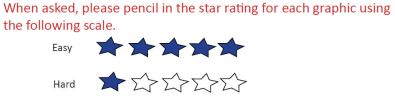
I designed a simple survey that allowed us to gather data on those four dimensions using an implicit five point scale, eliciting participation and dialogue with the audience at the same time. The graphic below provides a view of the survey’s instructions. The participants seemed overall to enjoy the approach and the evaluations confirmed the impression.
We drew the four dimensions from research done in 2010 by members of the Interaction Lab at the University of Saskatchewan. The Interaction Lab researchers designed an experimental study to test two basic questions: “first, whether visual embellishments do in fact cause comprehension problems; and second, whether the embellishments may provide additional information that is valuable for the reader.” I’m not going to detail the methodology used, however the researchers asked four questions to participants in the research as they reviewed graphics by Holmes with a great deal of visual embellishment or the same graphics after applying the data-ink ratio used by Tufte.
Q1–Subject: ‘What is the chart is about?‘ ‘Tell me about the basic subject of the chart.’
Q2–Values: ‘What are the displayed categories and values?‘ ‘Tell me how the chart is organized and any relevant values.’
Q3–Trend: ‘What is the basic trend of the graph?‘ ‘Tell me whether the chart shows any changes and describe these changes.’ (Note that this question was not relevant for pie charts.)
Q4–Value Message: ‘Is the author trying to communicate some message through the chart?‘ ‘Is the author trying to get across a specific point or is he or she merely presenting objective information?’
We reported on the major findings of the research team to the audience as follows:
There was no significant difference between plain and image charts for interactive interpretation accuracy (i.e., when the charts were visible).
There was also no significant difference in recall accuracy after a five-minute gap.
After a long-term gap (2-3 weeks), recall of both the chart topic and the details (categories and trend) was significantly better for Holmes charts.
Participants saw value messages in the Holmes charts significantly more often than in the plain charts.
Participants found the Holmes charts more attractive, most enjoyed them, and found that they were easiest and fastest to remember.
At the end of the presentation, after we covered the research study findings, we then asked the participants to list as many of the graphics from the four discussed earlier and to rate each along the four dimensions. As we broke up the session a few participants asked if we could share the findings from the participative survey.
I agreed to post the results and I am now getting around to it.
Back in 2006 Hugh Macleod offered the following point on Gapingvoid: “If people like buying your product, it’s because its story helps fill in the narrative gaps in their own lives.” At the time I thought it conveyed nicely the point made by Gerald Zaltman in How Customers Think that “companies should define customer segments on the basis of similarities in their reasoning or thinking processes” (p. 152) rather than constructs related to demographics. Hugh’s point made a lot of sense when I first read it and the point continues to gain in significance for me.
Hugh’s initial post sparked a range of interesting comments that I encourage anyone puzzled by the quote to read. The one point I’ll make about the topic is that nowhere in the post or the comments does anyone say what they mean by narrative gaps. I’ll attempt to clarify the concept below because it doesn’t simply mean stories. Stories that fill narrative gaps do so by purposively or accidentally creating personal curiosity, imagination, intrigue, or mystery for people experiencing them.
Narrative gaps in our personal stories are resolved through other stories about our own experience, perhaps with a product or service, that help us make sense of the feelings evoked. Specifically, Hugh noted in a later post that people fill in narrative gaps with meanings they construct from their own stories. It is on this point that the concept of personas becomes relevant to narrative gaps and to a recent conception of how to use social media robots, especially DigiViduals™, in qualitative research. Moreover, in this respect I suggest that the challenges involved are analogous to key ones faced by industrial robotics.
We know that most learning in the workplace is informal. Most observers put it at around 80%. Recently, John Hagel and John Seeley Brown contended that “as much as two-thirds of headcount time in major enterprise functions like marketing, manufacturing and supply chain management is spent on exception handling.” Of course, that fact is a result of the successes of process automation over the past few decades. Yet, still, The Barely Repeatable Process (BRP) persists as an organizational challenge for business.
Earlier discussions here focused on the importance of exceptions, to business process and formal learning. I examined the implications of the Kirkpatrick Evaluation model to the use of social media in learning experience design, while addressing the challenges facing learning leaders. Leading the Business-Centered Learning Experience noted that evaluating formal learning is as much about organizational learning and change management as it is about individual learning, largely because much of the learning, and performance, that matters today occurs at the group level. Marc Rosenberg recently echoed the point in an article in Learning Solutions Magazine, The Special Sauce of Social Learning. Marc noted that social learning is largely a change management challenge for organizations.
The most basic point to remember is that exceptions to formal business processes require efforts to design a scalable learning architecture that supports content co-creation needed to adapt to emergent challenges and manage the flow of that adaptation through an enterprise’s ecosystem. Whether judging an adaptation successful requires it to result in new formal learning content, i.e. content co-creation, or a new business process, i.e. organizational innovation, or both, remains an open question.
When an exception happens, we have to step away from our PowerPoint, stop typing an email, or exit a meeting in order to take care of it. Routine work stops. And, our modern reliance on technology to find, aggregate, and alert us to these exceptions has made the task of managing them more burdensome than ever before. Systems that manage exceptions provide the enterprise with vast amounts of data points that have become overwhelming for employees to handle. The applications that we rely on for managing exceptions still rely on process owners to make decisions and respond to the issues. The result is a workforce that isn’t dealing with exceptions well at all. (my emphasis)
The importance of social networking to increasing the effective handling of exceptions is a major focus for those interested in social learning.
I’ve discussed ethnography, especially digital ethnography, several times here taking note that, whether we use ethnography in marketing or design research remains irrelevant to the methods employed. What matters is whether we develop the research questions around the assumption that sociocultural practices provide the data source for answers. Ethnographers research settings, situations, and actions, with the goal of discovering surprising relationships. The most surprising relationships though are often hiding in plain sight, right under our noses.
I was recently pointed to a video from a link in the Yahoo Group Anthrodesign. The video, by Amy Krouse Rosenthal, provides a unique example of insights about people we can glean from designing situations that transgress established sociocultural practices. I actually watched it three times, and not because Time listed it in the top five viral videos of the week…kind of like people (at least some people) did when the moonwalking bear video came out. Rather, my interest in it was how the mere observation of the actions taken by pedestrians leads us to experience surprise. More on this below. For now, let’s consider the video itself.
After sticking labels on 100 one dollar bills, with a unique message written on each, and clipping those dollar bills to individual leaves on a tree, Ben, Brian, and Amy video recorded how people respond to money hanging on a tree as they walk by it on a street. The narrator, Amy, indicates no crowds showed up to grab all the money they could get, though a few did take more than one dollar at a time. Most people who took money, a minority, pulled a couple of dollars, or one, and moved on.
(UPDATE: You will need to click on the Watch on YouTube link to see the video. Some proprietary thing I’m sure) 😉
Amy offers two lessons learned from the Money Tree:
That people routinely walk by a “tree filled with free money” without even noticing
That people can look at a tree filled with money and not even see it
The Money Tree offers an example of what social psychology, but especially ethnomethodology, refers to as a breaching experiment. Breaching experiments typically involve a researcher breaking a rule about everyday life and then analyzing other people’s response. The Money Tree exemplifies a situation designed to break a tacit understanding about money and sidewalks.
“Money doesn’t grow on trees”, is a phrase most people in Chicago (the location of the Money Tree) probably know. We don’t routinely see money hanging from a tree along a sidewalk. It is certainly more common, as the bicyclist’s experience in the video shows, to see money on a sidewalk. And, I’d wager, most of us just think someone lost it. In other words, merely by setting up the situation to violate the pedestrians’ tacit knowledge of what walking down a sidewalk entails, the videographers show us something about people.
At the same time that the video offers us a surprising experience, it sure would be interesting to know what people who failed to take money were thinking. Anyone else find this interesting?
What do you think the typical manager might say if you told them their employees don’t gossip and engage one another enough in social interaction at work?
Most managers know about the water cooler effect. However, not enough understand the meaning of the concept and how it relates to performance and collaboration. People thinking about how to support collaboration and performance need to keep in mind the simple fact that employees don’t only gather around the water cooler or coffee pot to get a drink. They often use getting a drink of water, or a cup of coffee, as a pretext for taking a break, and information sharing happens incidentally as they interact in that informal process, sometimes playfully, with their peers and, in exceptional organizations, their managers.
A couple of studies released this summer dealing with performance and collaboration in teams merit consideration in this regard. Not so much for what they specifically say about performance and collaboration as much as what they imply about the importance of social relationships to both.
The consulting firm RW3 recently released a study of distributed teams, reporting that “40 percent of members on virtual teams believe their groups are underperforming”. We previously discussed such distributed teams, noting that team members often disagree with team leaders about who is, and is not, on the team. Michael Schell, CEO for RW3, noted in Chief Learning Officer magazine that, of the teams studied, “Half of these teams never meet in person…They don’t get time to create any kind of rapport, which is very important when you’re working across cultures.”
While the RW3 research points to a salient issue in distributed teams, it fails to acknowledge that merely recognizing and talking about the impact of cultural variation on performance and collaboration, whether in informal online meetings or in training, fails to address the main issue. Members of distributed teams perform more effectively when they understand one another as people as well as employees. Specifically,
Collaboration means getting to know that other employees possess expertise on this or that topic, but also developing comfort with one another by sharing significant symbols relating to self, family, friends, and social activities, thereby understanding one another as people.
Merely orchestrating virtual water cooler meetings on a regular basis does not address the issue, especially when management coordinates the meetings. As I observed in a previous post on the importance of empathy and collaboration to social business design,
People who identify with one another are more likely to share information proactively, without waiting for others to ask for it, because they understand how their own work relates to that of other people and see the flow of work from multiple points of view, spanning silos. Too many social computing experts view collaboration from within a command and control prism, assuming people collaborate because coordination and communication are part of their job description.
Effective collaboration really requires proactively sharing information with those it affects, not simply reacting to information requests. It means anticipating the future impact of actions you take on the responsibilities of other employees or business partners, or the needs of customers. People really don’t do this well unless they see other employees, and customers, as people too. Indeed, this is one of the main reasons that social networks increase in importance as collaboration decreases as a face to face activity.
Recent research on collaboration, performance, and job satisfaction in co-located teams provides useful findings to consider in thinking about what social networks add to the mix in distributed teams.
From "A Journey Round My Skull's" photostream on Flickr
Digital ethnography is an increasingly feasible research technique as smartphones decrease in cost and more people carry them around. The photographic capability of smartphones is an important resource in making digital research ubiquitous, giving people the ability to capture images and record observations as they go about their everyday lives, and characterize those observations for ethnographers.
Of course, taking photographs and sharing them online as part of a diary or journal for ethnographic research predates smartphones. Smartphones simply increase the likelihood that an everyday experience is recorded as a representation of the moment in which it occurs. Nevertheless, the video recording capabilities of smartphones afford collaborators an opportunity for representing experience in a manner previously unavailable to ethnographic research.
I’ll discuss the range of implications for ethnography posed by the ubiquitous access to video recording capabilities by ordinary people in another post in the near future. For now, my discussion focuses on how to use video in ethnographic research to inform product/service design.
Video of people using products or services is one of the most challenging data resources used in ethnographic research. Playing and replaying video segments for review is time-consuming and, depending on the number of people involved and the type of activity recorded, difficult to distil into agreed-upon insights.
I recently read several chapters from Sarah Pink’s Visual Interventions: Applied Visual Anthropology, thoroughly enjoying all of them. One chapter in particular though, Video Ethnography Under Industrial Constraints, by Werner Sperschneider, really caught my attention. Werner spells out a technique (the Video Card Game) for analyzing video in design research that I remembered reading about several years ago but, at the time, didn’t really give a lot of thought to.
The Video Card Game draws from the “Happy Families” childrens’ card game, a game in which players collect families of four cards as they ask one another in turn for cards of a particular archetype. The goal of “Happy Families” is to collect a family of four cards, forming a stack. Collecting the most stacks makes you the winner.
Werner provides an overview of how researchers in user-centered design at the Danish industrial manufacturer, Danfoss A/S, initially created the Video Card Game as a method for combining ethnographic and visual research methods using video. Design researchers, Margot Brereton, Jared Donovan, Stephen Viller, at the University of Queensland, as well as Jacob Buur and Astrid Soendergaard, of the University of Southern Denmark, and the University of Aarhus, respectively, also provide case studies of its use.
Family Resemblance and the Video Card Game
The Video Card Game’s design provides a collaborative space of interaction for researchers, designers, and design collaborators to co-create insights for product and service design, using video as a primary source of insight. The rendition of the game offered here refers to it as the Video Card Family Game for the explicit purpose of making it clear that Ludwig Wittgenstein’s concept of family resemblance is a key criteria in the gaming process for deciding to which themes a video card belongs. Using the concept of family resemblance to analyze video enables design researchers to organize, prune, and interpret actions taken in their research with collaborators in the field, providing actionable ideation outcomes.
When playing the Video Card Family Game the key is remembering that, even though the cards give the video a tangible mode of expression, the images remain on relatively small cards, whether on the surface of a table or attached to a poster on the wall. One can imagine an interactive wall display like Microsoft’s Surface that minimizes the legibility problem. Short of such a solution however it is important to keep in mind the spatial limitations imposed by rendering video representations of action onto tangible video cards arranged on tables or walls.
Keep reading if you are curious about how the Video Card Family Game is played in the context of video analysis for design research.
Skilful Minds discusses Experience Design
and the ways it matters to client stakeholders, whether users, consumers, customers, learners, or just plain people.


 Posted by Larry Irons











 What do you think the typical manager might say if you told them their employees don’t gossip and engage one another enough in social interaction at work?


